[tech4all] Trips to Mars in 39 Days
Trips to Mars in 39 DaysWritten by Nancy Atkinson 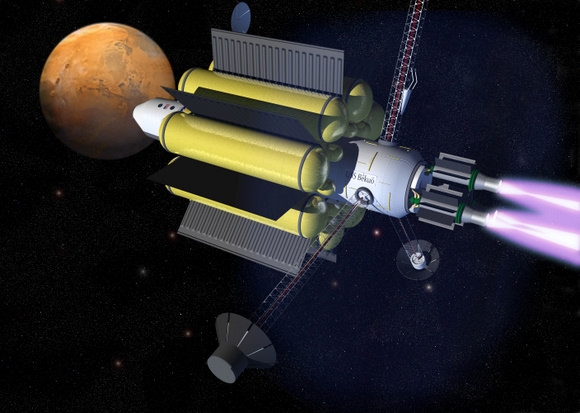 Using traditional chemical rockets, a trip to Mars – at quickest — lasts 6 months. But a new rocket tested successfully last week could potentially cut down travel time to the Red Planet to just 39 days. The Ad Astra Rocket Company tested a plasma rocket called the VASIMR VX-200 engine, which ran at 201 kilowatts in a vacuum chamber, passing the 200-kilowatt mark for the first time. "It's the most powerful plasma rocket in the world right now," says Franklin Chang-Diaz, former NASA astronaut and CEO of Ad Astra. The company has also signed an agreement with NASA to test a 200-kilowatt VASIMR engine on the International Space Station in 2013. The tests on the ISS would provide periodic boosts to the space station, which gradually drops in altitude due to atmospheric drag. ISS boosts are currently provided by spacecraft with conventional thrusters, which consume about 7.5 tons of propellant per year. By cutting this amount down to 0.3 tons, Chang-Diaz estimates that VASIMR could save NASA millions of dollars per year. The test last week was the first time that a small-scale prototype of the company's VASIMR (Variable Specific Impulse Magnetoplasma Rocket) rocket engine has been demonstrated at full power. Plasma, or ion engines uses radio waves to heat gases such as hydrogen, argon, and neon, creating hot plasma. Magnetic fields force the charged plasma out the back of the engine, producing thrust in the opposite direction. They provide much less thrust at a given moment than do chemical rockets, which means they can't break free of the Earth's gravity on their own. Plus, ion engines only work in a vacuum. But once in space, they can give a continuous push for years, like wind pushing a sailboat, accelerating gradually until the vehicle is moving faster than chemical rockets. They only produce a pound of thrust, but in space that's enough to move 2 tons of cargo. Due to the high velocity that is possible, less fuel is required than in conventional engines. Currently, the Dawn spacecraft, on its way to the asteroids Ceres and Vesta, uses ion propulsion, which will enable it to orbit Vesta, then leave and head to Ceres. This isn't possible with conventional rockets. Additionally, in space ion engines have a velocity ten times that of chemical rockets.  Specfic impulse and thrust graph. Credit: NASA Rocket thrust is measured in Newtons (1 Newton is about 1/4 pound). Specific impulse is a way to describe the efficiency of rocket engines, and is measured in time (seconds). It represents the impulse (change in momentum) per unit of propellant. The higher the specific impulse, the less propellant is needed to gain a given amount of momentum. Dawn's engines have a specific impulse of 3100 seconds and a thrust of 90 mNewtons. A chemical rocket on a spacecraft might have a thrust of up to 500 Newtons, and a specific impulse of less than 1000 seconds. The VASIMR has 4 Newtons of thrust (0.9 pounds) with a specific impulse of about 6,000 seconds. The VASIMR has two additional important features that distinguish it from other plasma propulsion systems. It has the ability to vary the exhaust parameters (thrust and specific impulse) in order to optimally match mission requirements. This results in the lowest trip time with the highest payload for a given fuel load. In addition, VASIMR has no physical electrodes in contact with the plasma, prolonging the engine's lifetime and enabling a higher power density than in other designs. To make a trip to Mars in 39 days, a 10- to 20-megawatt VASIMR engine ion engine would need to be coupled with nuclear power to dramatically shorten human transit times between planets. The shorter the trip, the less time astronauts would be exposed to space radiation, and a microgravity environment, both of which are significant hurdles for Mars missions. 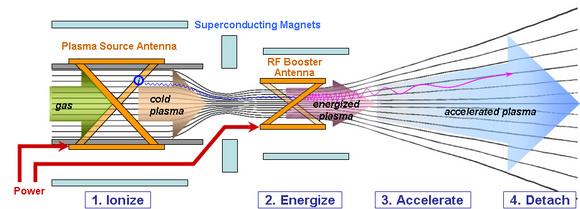 VASIMR. Credit: Ad Astra The engine would work by firing continuously during the first half of the flight to accelerate, then turning to deaccelerate the spacecraft for the second half. In addition, VASIMR could permit an abort to Earth if problems developed during the early phases of the mission, a capability not available to conventional engines. VASIMR could also be adapted to handle the high payloads of robotic missions, and propel cargo missions with a very large payload mass fraction. Trip times and payload mass are major limitations of conventional and nuclear thermal rockets because of their inherently low specific impulse. Chang-Diaz has been working on the development of the VASIMR concept since 1979, before founding Ad Astra in 2005 to further develop the project. Source: PhysOrg |
Add whatever you love to the Yahoo! India homepage. Try now!
__._,_.___

Change settings via the Web (Yahoo! ID required)
Change settings via email: Switch delivery to Daily Digest | Switch format to Traditional
Visit Your Group | Yahoo! Groups Terms of Use | Unsubscribe
.
__,_._,___
posted by Bharath @ 1:25 PM
0 comments


